NAVIGATING THE UNDERCOUNT RISK IN CENSUS 2020
When it comes to the upcoming 2020 Census, the risk of an undercount is rooted in two (overlapping) factors: 1) general undercount risks (e.g. underfunding, change in leadership, distrust of government) and, 2) the proposed citizenship question. Below is a summary of recent research that highlights the risk of failing to count all individuals in the upcoming census.
GENERAL UNDERCOUNT RISKS
In their June 2019 report, Assessing Miscounts in the 2020 Census, the Urban Institute provides a comprehensive assessment of the potential undercount in the 2020 Census. The report takes into account several factors, including insufficient funding for the Census over the past decade, the introduction of internet response option, the use of administrative records to reduce Non-Response Follow-up (NRFU) field work, and the proposal to include a citizenship question.
The report presents the cumulative risk to census undercount across these factors, in High, Medium, and Low Risk scenarios. The authors project the census undercount at national and state levels, and by race/ethnicity and age. The report finds:
The total U.S. undercount could range from approximately 900,000 people to over 4 million people on the 2020 Census
Black and Hispanic/Latinx individuals could be undercounted nationally at a rate as high as 3.7 percent and 3.6 percent, respectively
Follow the link above for the full report or check out the Urban Institute’s data page for additional findings.
CITIZENSHIP QUESTION UNDERCOUNT RISK
On April 23, the Supreme Court heard opening arguments in the case that will determine whether a the proposed citizenship question will appear on the 2020 Census. Since this controversy began in early 2017, researchers have been trying to understand how a proposed citizenship question will impact overall response rates.
Recent studies have found that the citizenship question will impede the mandate to ensure that everyone is fairly and accurately counted.
A Harvard study estimates that the citizenship question could lead to an undercount of roughly 6 million (12 percent) of the Latinx population nationally
A study by UCLA researchers concluded that 7 to 10 percent of the U.S. population, including 11 to 18 percent of immigrants, and 14 to 17 percent of Latinx individuals would not respond to a census with a citizenship question
For more on research quantifying the impacts of a citizenship question, read this Washington Post story.

UNDERSTANDING “DIFFERENTIAL PRIVACY”
The U.S. Census Bureau collects sensitive data from individuals and households, publishing demographic data that is essential for telling the story of Americans and their communities. Under Section 9 of the Census Act, U.S. Code Title 13, as a “trusted curator” the Bureau is required uphold respondent privacy in data that are released publicly. To meet this requirement, the Census Bureau typically releases aggregate-level data (i.e. census block, block-group, or tract) and implements various disclosure avoidance techniques (e.g. collapsing data, variable suppression). More recently however, modern computational methods, combined with more publicly available data, has increased the risk of exposing individual privacy. In response, the Bureau has explored approaches for modernizing disclosure avoidance.
WHAT IS DIFFERENTIAL PRIVACY?
Differential privacy includes various techniques aimed at limiting available aggregate information to protect individual privacy. More specifically, differential privacy attempts to balance privacy loss and accuracy through mathematical formulas. Once the limit for acceptable privacy loss is established (this is part of the current debate), measures including adding synthetic data (or introducing “synthetic noise”), data-swapping, and data imputation can be used to ensure that the database is sufficiently safeguarded from reconstruction and individual identification.
DIFFERENTIAL PRIVACY AND THE CENSUS
The U.S. Census Bureau has expressed interest in implementing differential privacy in the 2020 Census. In practice, the Census Bureau would need to set a limit for the amount of disclosure avoidance that balances privacy with data utility and accuracy. Given the importance of decennial census and ACS data, it is critical to understand the impact that differential privacy will have on data availability, particularly for cross-tabulated data (e.g. poverty by race/ethnicity), microdata (e.g. Public Use Microdata Sample or PUMS), and for small-area geographies (e.g. census blocks).
In October 2019, the Bureau released demonstration data that applies differential privacy to Census 2010 data. Since then, academics, policymakers, and other data users have examined how Census 2010 test data can yield different policy results. These studies have been presented or were featured in the following meetings/events:
CNSTAT Expert Meeting on Disclosure Avoidance
June 2020. DAS Updates, by Michael Hawes.
June 2020. Metrics Updates, by Christine Borman and Matthew Spence.
2020 Disclosure Avoidance System (DAS)
Committee on National Statistics
WHERE CAN I GET THE CENSUS 2010 TEST DATA?
For novice users, one of the transparent and user-friendly tools for examining differences between actual Census 2010 data and Census 2010 test data is from ESRI:
For more advanced data users interested in examining data in a statistical data package, the data are available from:
WHAT ARE THE CONCERNS ABOUT DIFFERENTIAL PRIVACY?
A white paper written by Census Bureau staff acknowledges that differential privacy “lacks a well-developed theory for measuring the relative impact of added noise on the utility of different data products, tuning equity trade-offs, and presenting the impact of such decisions.” By adjusting the perceived demographic composition of communities, differential privacy has the capacity to disproportionately impact racial/ethnic minorities and underrepresented individuals. Communities where individuals of color make up a small percentage of the population, for example, may require data swapping to a different tract or block group to meet the privacy limits set under differential privacy protocol.
The Minnesota Population Center (MPC) outlines a number of concerns regarding differential privacy. The MPC recommends the following points be addressed before differential privacy policies are implemented:
More testing is needed before final decisions are made on how differential privacy will be applied to census data.
Differential privacy is not appropriate or feasible for ACS microdata (e.g. PUMS).
For all data products, the Census Bureau should proceed cautiously in close consultation with the data user community.
DIFFERENTIAL PRIVACY IN THE NEWS
May 2020
April 2020
“Census 2020 Will Protect Your Privacy More than Ever—But at the Risk of Accuracy,” by Nicholas Nagle. The Conversation
March 2020
“Modernizing Disclosure Avoidance: What We’ve Learned, Where We Are Now,” by John M. Abowd and Victoria A. Velkoff. US Census Bureau
February 2020
US Census Bureau Response to Federal State Cooperative for Population Estimates (FSCPE) Questions Surrounding Differential Privacy
FOR MORE INFORMATION
This topic is ever-evolving. As such, this post will be updated to make the most current information available.
Good, less-technical overviews:
“To Reduce Privacy Risks, the Census Plans to Report Less Accurate Data,” by Mark Hensen, New York Times (December 2018)
“Potential privacy lapse found in Americans' 2010 census data.” NBC News, (February 2019).
More in-depth, technical resources:
Modernizing Disclosure Avoidance: A Multipass Solution to Post-Processing Error,” by John Abowd and Victoria Velkoff. U.S. Census Bureau (June 2020).
Dear Differential Privacy, Put Up or Shut Up, by Paul Francis. Medium (January 2020).
Oregon Census State Data Center (SDC) Annual Data Users Conference (October 2019)
“New Privacy Measures for the 2020 Census.” Michael Hawes.
“Status Update on the 2020 Census Data Products Plan.” Marc Perry and Rachel Marks.
Differential Privacy, An Easy Case. Mark Hansen (January 2019).
Innovating Data Privacy for the American Community Survey. -Rolando Rodriguez and Amy Lauger (2019).
Challenges and New Approaches for Protecting Privacy in Federal Statistical Programs. National Academies, Committee on National Statistics (2019).
Changes to Census Bureau Data Products. University of Minnesota, IPUMS webpage (2019).
ARCHIVE
In a presentation at the American Community Survey (ACS) Data Users Group (DUG) meeting in May 2019, Dr. Connie Citro recommended the Bureau consider the following points as they move forward on differential privacy:
An observation and recommendation by Dr. Citro: “taking the relationship between the Census Bureau and users to the next level of systematic, two-way interaction. That relationship, in my experience going back over 50 years, is not yet there” (Slide 3).
To build credibility among data users (Slide 7), Dr. Citro calls on the Bureau to: “institutionalize systematic, two-way, transparent interaction—structured input, dialog, preliminary decision, [repeat], and document the final decision (Slide 8).
Dr. Citro offers a number of “Ways and Means to Step Up” (Slides 11-13).

CHALLENGE #1: IMPLICATIONS OF INADEQUATE CENSUS FUNDING
The struggle to adequately fund the 2020 Census has been closely followed by a number of outlets, including a number of posts on this website. According to the Census Project, the Trump Administration’s FY2020 funding request for the Census Bureau falls approximately $2 Billion short of what is needed to carryout the 2020 enumeration.
Below we outline some of the ramifications to date for inadequate funding for the Bureau. There are certain to be other implications moving forward, especially if the Bureau continues to be underfunded in FY2020.
1. Cancelled testing in suburban and rural areas
Prior to each decennial census, the Census Bureau conducts a "dress rehearsal" to test outreach, data collection methods, and technology. Due to reduced funding, the Bureau announced cuts to 2017 field testing in reservation lands in the Dakotas and Washington State, as well as in Puerto Rico. More recently, the Bureau announced additional cuts for 2018 field testing in West Virginia and Washington State.
Field testing is critical, especially for 2020, because unlike previous decennial censuses, Census 2020 will allow respondents to fill out their forms via the internet. This decision, driven to a large degree to reduce costs of administering the census, means there will be roughly half of the field offices as in Census 2010.
2. Reduction in the number of local census offices and field staff
Part of the justification for fewer Area Census Offices (ACOs) and field staff is that Census 2020 will be “smarter” because of its reliance on digital technology. These potential efficiencies, however, might be offset by various unforeseen technological challenges and other issues (e.g. proposed citizenship question).
3. Delay of the Economic Census
Due to low funding levels at the Bureau, funding for the 2017 Economic Census was used to support efforts to keep the 2020 Census on track. Data collection for the 2017 Census was delayed approximately 6 months when compared to the 2012 Economic Census and data releases were delayed 9 months relative to the 2012 survey.

CHALLENGE #1: UPDATE - ANALYZING THE TRUMP ADMINISTRATION'S 2020 BUDGET REQUEST
The Council of Professional Associations on Federal Statistics (COPAFS), which focuses on providing government policy decision makers with information that demonstrates the value of federal statistics, recently released their analysis of the Trump administration’s proposed FY 2020 budget. The administration’s FY 2020 request calls for roughly $5.3 billion to support Census 2020. According to COPAFS, this number, even when paired with the additional $1 billion from FY19 appropriations, still falls short of the funding that the Census Bureau calls for in their 2020 Census Life-Cycle Cost Estimate document.
Another notable impact affecting the U.S. Census Bureau is the Trump administration’s continued call for consolidating the U.S. Census Bureau, the Bureau of Economic Analysis (BEA), and the Bureau of Labor Statistics (BLS).
The President’s budget request is a starting point for creating the FY2020 federal budget. Congress may consult the administration’s proposal as they work toward fleshing out more budget details in the coming months.
To read the entire analysis by COPAFS, follow this link.
CHALLENGE #3: CITIZENSHIP QUESTION AND SCOTUS
Just one week after a federal judge in Washington ruled in favor of the U.S. Commerce Department by denying a request to block a citizenship question on the 2020 Census, the U.S. Supreme Court announced Friday, February 15 that they intend to hear arguments on the question.
Timeline. The justices are expected to hear the case on April 23, 2019, and release their decision by the end of June. This proposed timeline is being driven, in part, by a tight turnaround for printing the census forms. According to officials, the finalized form must be sent to the printers no later than June 2019.
A more detailed article about the U.S. Supreme Court announcement can be found here.
CHALLENGE #3: A CITIZENSHIP QUESTION TIMELY UPDATE
On February 8, 2019, Dabney L. Friedrich, a federal judge in Washington D.C., ruled in favor of the U.S. Commerce Department by denying a request to block the citizenship question on the 2020 Census. This case, one of several cases across the U.S., was filed by the Electronic Privacy Information Center (EPIC). The plaintiffs challenged the decision to include the citizenship question by arguing that a privacy impact assessment should have been completed prior to adding the citizenship question on Census 2020 form.
On March 6, 2019, Richard Seeborg, a federal judge in California, became the second federal judge to block the administration’s plans for a citizenship question on the 2020 Census. Back in January 2019, New York District Court Judge Jesse Furman was the first judge ordering the administration to remove the citizenship question from the Census 2020 form.
What does this mean?
With one judge (i.e. Friedrich) ruling in favor of the administration and three ruling against (i.e. Seeborg, Furman, and Hazel), the decision now lies in the hands of the U.S. Supreme Court. More information is available here.
More information about EPIC v. Commerce can be found here.
More information on Judge Seeborg’s decision can be found here.
More information on Judge Hazel’s decision can be found here.

CHALLENGE #1: FUNDING UPDATE - SHUTDOWN EDITION (JANUARY 2019)
On December 22, 2018, the federal government entered a partial shutdown, furloughing approximately 800,000 federal employees. The U.S. Census Bureau is among the federal agencies without an approved budget for FY2019. However, as part of the FY2018 appropriations process, the Bureau received close to $1 billion in FY2019 for 2020 Census preparations. The Bureau estimates that these funds can support 2020 decennial work into February, 2019 without impacting the decennial enumeration. Critics have their doubts.
How did the Bureau run out of funding at such a critical juncture? The 115th Congress adjourned without agreeing on how to best fund the Bureau in FY2019, leaving it to the next Congress to reconcile the FY2019 House ($4.8B) and Senate ($3.8B) funding bills, which differ by approximately $1 billion. The primary difference between these funding levels, according to the Census Project, is that the House bill assumes that between $1.6B and $1.8B of the FY2019 appropriation will actually be spent in Quarter 1 of FY2020. Therefore, the House bill would appropriate only $3.4B in funding for FY2019.
Image courtesy of the U.S. Census Bureau (2018).
The Takeaway
Without a quick end to the already historically long government shutdown, the 2020 Census could be in serious trouble. At a time when the program should be ramping up by opening local offices, it’s imperative that Congress support expanded partnership staff and experts, a stepped-up communications campaign, and larger field infrastructure. Right now, the Census is operating on what equates to emergency funding. Before too long, this could have major implications for the decennial census, which is set to begin in earnest in Alaska in January 2020.
For more information, check out these resources:
2018, July. Update on FY2019 Census Bureau Budget Action So Far. The Census Project.
2018. Fiscal Year 2019 Budget Summary ($3.8 billion). U.S. Census Bureau.
2018, June. House, Senate Bills Split on Census Funding. FCW. Authored by Chase Gunter.
2019, January. What the Shutdown Means for the Census. CitiesSpeak. Authored by Brian Egan.
2019, January. The Census Bureau says work on the 2020 count can go on for weeks. Experts say they have their doubts. Washington Post. Authored by Tara Bahrampour.

CHALLENGE #3: A CITIZENSHIP QUESTION AND CENSUS 2020: QUANTIFYING THE UNDERCOUNT RISK IN OREGON
The decision by U.S. Secretary of Commerce, Wilbur Ross, to include a citizenship question on the upcoming 2020 Census has generated much controversy. On January 15, 2019, a federal judge in New York District Court, Jesse Furman, ordered the administration to remove the citizenship question from the Census 2020 form. For now, Judge Furman’s decision means that respondents will not be asked about their citizenship in the 2020 census. On Thursday, January 16, 2019, the Trump administration filed paperwork challenging this order, and is now asking the U.S. Supreme Court to take the court case.
The census, held every 10 years, is charged by the U.S. Constitution to count everyone. Securing a fair and accurate count is not only critical for determining political representation, but also ensures fair distribution of federal resources to state, county, and local municipalities. The concern among many is that the citizenship question would yield lower census response rates among certain groups, namely non-citizens, persons of color, children, and individuals of lower socioeconomic status. The lower response rates generated by the citizenship question, combined with a tendency to undercount these groups in the first place, together would increase the overall census undercount, effectively leading to underrepresentation. Census advocates point to other concerns about the question as well, including: an unclear and uncertain justification for adding the question, and the question not being formally tested by the U.S. Census Bureau.
To quantify the undercount risk of the citizenship question in Oregon, we followed a framework outlined in a recent article by Beth Jarosz of the Population Reference Bureau (PRB). Using data from the American Community Survey (ACS), we set out to estimate how many Oregon residents live in a household with at least one non-citizen, principally because these households would be more likely to be undercounted. We report the following four takeaways for Oregon:
Total Population. The data show that nearly a half-million (456,900), or almost 1 in 9 Oregonians live with at least one non-citizen, meaning they would be more likely to be undercounted with a citizenship question in the upcoming decennial census.
Age. Children are more likely to live with at least one non-citizen, meaning that children would be more likely to be undercounted. Some 162,000 Oregonians 19 years and under live with a non-citizen, including almost 1 in 5 children between 0-9 years of age (Table 1). Children are already a historically undercounted group; a citizenship question would make it more difficult to accurately count children in Oregon and across the U.S.
Race/Ethnicity. A citizenship question would make it more difficult to count Oregonians of color. Roughly 78% of Oregonians living with a non-citizen are persons of color, despite making up 24% of the state’s population (Table 2). Individuals of color more likely to be undercounted include Asian or Pacific Islander and Hispanic individuals, where 43% and 53% live with at least one non-citizen, respectively.
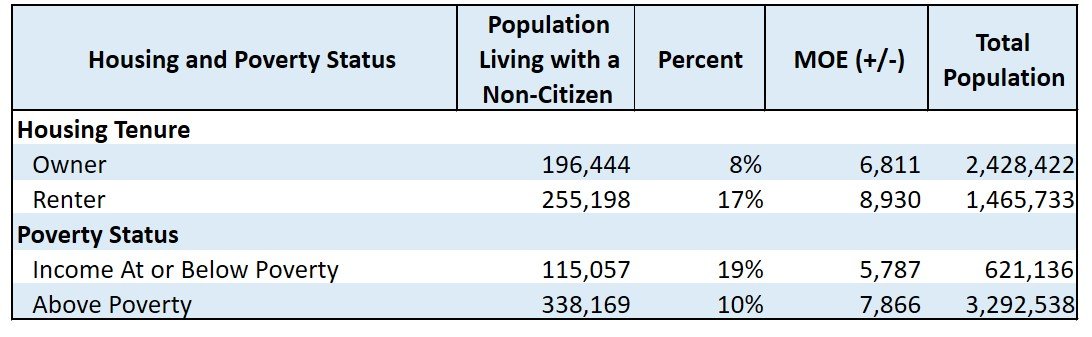
Housing Tenure and Poverty. A citizenship question would also make it more difficult to count Oregonians with limited means. Roughly 17% of Oregon renters and 19% of Oregonians living below the poverty level live with non-citizens, and are at elevated risk of being undercounted (Table 3). Renters make up about 37% of Oregon’s population but comprise nearly 56% of the population at risk of being undercounted. Similarly, Oregonians living below the poverty level make up 16% of the Oregon population but make up nearly 26% of the at-risk population.
Table 1. Oregonians Living With at Least One Non-Citizen by Age Cohort, 2012-2016.
View fullsize
Source: American Community Survey (ACS), Public Use Microdata Sample (PUMS), 2012-2016 (five-year combined estimates)
Table 2. Oregonians Living With at Least One Non-Citizen by Race/Ethnicity, 2012-2016.
View fullsize
Source: American Community Survey (ACS), Public Use Microdata Sample (PUMS), 2012-2016 (five-year combined estimates)
Table 3. Oregonians Living With at Least One Non-Citizen by Housing Tenure and Poverty Status, 2012-2016.
View fullsize
Source: American Community Survey (ACS), Public Use Microdata Sample (PUMS), 2012-2016 (five-year combined estimates)
A printer friendly version of this article can be accessed here.

Source: American Community Survey (ACS), Public Use Microdata Sample (PUMS), 2012-2016 (five-year combined estimates)

Source: American Community Survey (ACS), Public Use Microdata Sample (PUMS), 2012-2016 (five-year combined estimates)
Source: American Community Survey (ACS), Public Use Microdata Sample (PUMS), 2012-2016 (five-year combined estimates)
![CHALLENGE #2: CHANGE IN LEADERSHIP [UPDATE]](https://images.squarespace-cdn.com/content/v1/5d21341a6f941b0001d6edad/1643316065967-25JFONJC3PXBO2UVODZ6/image.jpeg)
CHALLENGE #2: CHANGE IN LEADERSHIP [UPDATE]
On Wednesday, January 2, 2019, the U.S. Senate unanimously voted to approve President Trump’s nominee for Director of the U.S. Census Bureau, Dr. Steven Dillingham. Dr. Dillingham has more than 25 years of statistical, research, senior management, and legal experience in the federal government. He previously served as Director of the Bureau of Justice Statistics and the Bureau of Transportation Statistics. Both of these agencies support national surveys in partnership with the Census Bureau. Dr. Dillingham earned his BA at Winthrop University, received his JD, MPA, and PhD from the University of South Carolina, and completed his MBA at George Washington University and LLM at Georgetown University.
Dr. Ron Jarmin, a government economist who served as the Interim Director of the Census Bureau following former Director John Thompson’s resignation in 2017, is expected to fulfill the role of Deputy Director of the U.S. Census on a permanent basis.
For more information:
2019. Senate Confirms Trump’s Census Bureau Director Nominee Steven Dillingham. NPR. Authored by Hansi Lo Wang.