CRAFTING YOUR CENSUS CAMPAIGN PLAN
In July 2019, Census Counts hosted a webinar on crafting a census campaign plan. The session walked through some fundamental steps to create a campaign plan that will help your organization meet its mission surrounding the 2020 Census.
The webinar provided some useful tools to getting started with your campaign plan, including a template for crafting goals, strategies, and tactics through budgeting and reporting. The presentation also steps through how to build a budget to ensure your campaign is designed to your organization’s financial capacity.
If you were not able to view the webinar last month, or if you need a refresher on crafting your campaign plan, Census Counts posted the video and the slide deck.
Also be sure to check out upcoming Census Counts webinars outlined in an earlier post.

CENSUS COUNTS
Census Counts is a collaborative campaign involving more than 15 national organizations and dozens of community partners working together to make sure that the 2020 Census is fair and accurate.
Census Counts recently released a Digital Academy, funded by Census Funders Collaborative, to help build the digital capacity of local complete count committees and community organizations. The academy is divided into two parts: 1) short digital organizing videos and, 2) a series of online digital organizing trainings.
Digital organizing videos include:
Digital organizing webinars include:
Crafting Your Census Campaign Plan (July 24)
Assessing Your Digital Readiness for GOTC (August 8)
Content Strategy for HTC Communities (September 10)
Developing Your Hard to Count List (September 25)
Optimizing your GOTC Program (October 8)
Be sure to pass these dates on to your local partners and keep an eye out for additional resources from Census Counts.

CENSUS ACADEMY
Videos demonstrating how to access and utilize various census data sets are featured in the U.S. Census Bureau’s Census Academy, an essential online training hub for data users of all skill levels.
At Census Academy, novice data users can improve their familiarity with census data. More advanced data users can sharpen their analytic skills. Some of the Census Academy assets include:
“Data gem” videos that detail short “how-to” procedures for utilizing key data tools
Courses that help users learn at their individual pace and offer support for data analysis tools (e.g. crunching census data with Microsoft Excel and running statistical analyses in the R statistical package)
Webinars provide a chance to learn from and interact with the Bureau’s data experts
The Census Academy also provides an opportunity to receive customized training on specific topics, simply by inviting a data expert to your office for training, free of charge. For more information, check out the Census Academy website.
Upcoming sessions on Census Academy (from the U.S. Census Bureau)
PART 1: The ACS & Your Community by the Numbers (Tuesday, June 11, 10:30-11:15 a.m. EDT)
Income & Poverty Related Statistics (Thursday, June 13, 10:30-11:45 a.m. EDT)
SIPP Webinar Series: Jobs (Monday, June 17, 2-3:30 p.m. EDT)
PART 2: The ACS & Your Community by the Numbers(Tuesday, June 18, 10:30-11:15 a.m. EDT)
SIPP Webinar Series: Assets, Income, and Poverty (Tuesday, June 18, 2-3:30 p.m. EDT)
Census Data Made Easy: Age Statistics (Wednesday, June 19, 11 a.m.-12 p.m. EDT)
All About American Caribbean People (Thursday, June 20, 10:30-11:30 a.m. EDT)
New Updates to data.census.gov – June 2019 (Thursday, June 20, 2-3 p.m. EDT)
SIPP Webinar Series: Programs, Adult Well-Being, and Food Security (Thursday, June 20, 2-3:30 p.m.)
Small Business Administration: Financing Export Development Activities (Thursday, June 20, 2-3 p.m. EDT)
SIPP Webinar Series: Health Insurance, Health Care, and Disability (Monday, June 24, 2-3:30 p.m. EDT)
Census Data Made Easy: American FactFinder Tips and Tricks (Tuesday, June 25, 11 a.m.-12 p.m. EDT)
Census Data Made Easy: Website Resource Tour (Tuesday, June 25, 11 a.m.-12 p.m. EDT)
SIPP Webinar Series: Family and Fertility (Tuesday, June, 25, 2-3:30 p.m. EDT)
Accessing Quarterly Workforce Indicators in Census Business Builder (Wednesday, June 26, 1:30-2:30 p.m. EDT)
Hispanics in the Nation (Wednesday, June 26, 3-4 p.m. EDT
Archived Training Resources — Visit the U.S. Census Bureau’s Educational Resource Library for previously recorded trainings that are free and available at your convenience. The library includes presentations, recorded webinars, tutorials and other helpful materials.

UNLOCKING THE POWER OF THE CENSUS: A DATA TOOLBOX
U.S. Census data are essential for telling the story of individuals and communities alike. These data can be paired with other resources, such as public health statistics, housing data, or historical survey data, to help inform data analysis. This blog post—a virtual toolbox—highlights some of the best data tools available in the digital environment. Let us know if we’re missing your favorite data resource by reaching out to us on Twitter @Census2020Now.
Data Stories
MoA hosts wide ranging research and data stories with the goal of providing methodologically sound tools for understanding well-being and opportunity in America.
Data USA provides data stories, visualization builders, and mapping resources to effectively tell the story of education, industries, jobs, and cities across the U.S.
U.S. Census Bureau’s America Counts
The America Counts program offers a library of stories underscoring the importance of census data, and programs, that are important to the day-to-day life of every American.
Mapping Resources
Urban Research Maps - Visualizing Changes
The Urban Research Maps provides an easy way to compare population changes between 2000 and 2010 Census data in 15 large U.S. metropolitan areas.
The Opportunity Atlas aims to answer which neighborhoods in America offer children the best chance to rise out of poverty.
Center for Disease Control’s 500 Cities Project
The 500 Cities Project evaluates the burden and geographic distribution of health-related variables in America’s 500 largest cities.
Urban Institute Interactive Maps
The Urban Institute hosts a range of interactive maps on metropolitan economics, including trends on housing, public schooling, and poverty.
NHGIS provides historical GIS-compatible boundary files dating back to 1790 available at the state, county, tract, and block level. NHGIS also includes time series and summary tables for population, agriculture, housing, and economic data.
The National Association of Counties (NACO) provides this mapping tool to help compare county to county data with numerous criteria across 14 major categories.
Policy Map provides a wide range of mapping features, ranging from demographic and health statistics to a study of eventual household income for people raised in very low income families (per Opportunity Insights).
Tabular Data & Visualizations
HUD’s Comprehensive Housing Affordability Strategy (CHAS) data
HUD’s CHAS data tool generates data tables for the most commonly requested Comprehensive Housing Affordability Strategy (CHAS) data. The most recent data comes from 2011-15 ACS 5 year estimates.
Courtesy of the Missouri Census Data Center, CAPS provides small-area data from block, block group, or tract levels summarized into a customizable circular area.
Census Bureau’s Data Visualization Gallery
The Data Visualization Gallery highlights the accessibility of Census data by capturing historical changes in population growth and distribution, household and family dynamics, and economic indicators.

NEW CHANGES COMING TO THE 2020 CENSUS
In a recent article in the Washington Post, authors Ted Mellnik and Reuben Fischer-Baum highlight new approaches implemented by the U.S. Census Bureau to plan, educate, and motivate respondents for Census 2020. Some key changes include:
The U.S. Census Bureau has made extensive use of aerial imagery to confirm addresses for 2020, rather than sending census workers to complete the task (video for mapping wonks);
It’s estimated that it will cost $15.6 Billion to count roughly 330 million Americans in 2020;
A more technologically-driven and automated census means:
The Bureau will employ 475,000 census takers, down from roughly 600,000 census takers in Census 2010 (largely due to the internet response option);
Census takers conducting non-response follow-up will collect census data using an iPhone 8s, and;
The Bureau plans to spend a record $1.43 per U.S. resident on marketing for the 2020 Census, compared to $1.22 per resident in Census 2010.

FUNDING COMMUNITY-BASED OUTREACH (CBO) TO SUPPORT CENSUS 2020 IN OREGON
During the 2010 Census, nearly one in five (20.2) Oregon households did not initially mail back their census questionnaire. This population, considered “hard-to-count” (HTC), requires targeted community-based outreach (CBO) efforts to ensure everyone is counted in the census.
Image by Myredcoug from Pixabay
State and local governments, as well as philanthropic organizations, share a responsibility to secure funding that supports CBO efforts that will fairly and accurately count all Oregonians, including individuals in HTC communities. In April 2019, I co-authored a study with my colleague, Nick Chun, at the Population Research Center at Portland State University (PSU). We found that funding CBO efforts for Census 2020 in Oregon could require raising at least $7 to $8.4 million. The report calculates a funding target by largely following an approach outlined by the Fiscal Policy Institute.
To learn more about the methodology and assumptions used to calculate these figures, read the Population Research Center’s full report here.
New release as of June 7, 2019: The 2020 HTC Projections for Oregon counties are available here.

FORMING A COMPLETE COUNT COMMITTEE? IT'S ALL HERE.
Are you or your community considering forming a Complete Count Committee (CCC) for the upcoming 2020 Census? We are here to help get you started so that everyone in your community counts. Below are the steps required to organize a team and put a plan into action!
What are the basics of a CCC?
A CCC is a volunteer committee established by tribal, state, and local governments and community leaders to increase awareness of Census 2020 and increase census participation. Committees are most effective when they include a cross-section of the community, meaning the committee include individuals from government, education, business, religious organizations, the media, and community groups.
What are the advantages of a CCC?
Increased census response rates leading to lower undercount
Local input and broad community participation
Better organization and preparedness to avoid duplicating efforts
How many members should a CCC contain?
The size of each CCC depends on the size of your jurisdiction and the scope of your committee.
For example, smaller communities may have a committee of 3-5 individuals, where larger cities may have committees closer to 50 people, depending on who is engaged.
Who should be included on my Complete Count Committee?
Membership in municipal level CCCs often includes, but is not limited to:
Chair (often the mayor or a political designee)
Heads of government agencies and departments
Heads of community organizations
Representatives from diverse faith communities
Heads of universities and community colleges
Heads of business associations and private enterprise
Heads of public schools
Other individuals invested in achieving a fair and accurate count
Some members may need to be recruited, while others may join on their own accord. It is important to make sure that the CCC is representative of the larger community so that the committee can leverage relationships to access resources that support an infrastructure that achieves a fair and accurate census count.
What does a CCC need to actually do?
The CCC should prepare a Complete Count Plan that considers the locally specific barriers that exist to achieving a full and complete count.
A critical component of the planning phase requires that the CCC first identify sources of funding for the campaign.
In addition to planning and fundraising, the scope of CCC is rooted in three phases:
1. Education Phase. Raise community awareness and educated individuals about the importance of the census.
2. Promotion Phase. Notify and disseminate information to let the community know that the census is around the corner.
3. Motivation and Action Phase. Encourage people to stand up and be counted by completing their census form.
Need more information on CCCs?
For more information about CCCs, check out these links:
Guide to Municipal Complete Count Committee formation
Organizing for a Complete Count, MN State Demographic Center
Census 2020 CCC Guide, U.S. Census Bureau
Census 2010 CCC Guide, U.S. Census Bureau
Metropolitan Area Planning Council (MAPC) (Boston) Complete Count Committee training handout (2010)
TITLE 13 AND CONFIDENTIALITY OF CENSUS DATA

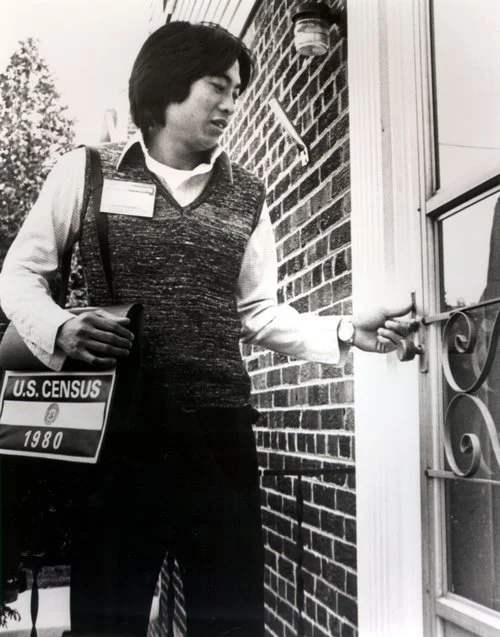
Image courtesy of Rob Pongsajapan, Flickr Creative Commons
As I travel across Oregon and speak with folks about Census 2020, a question that individuals ask me more than any other question is: “What can the U.S. Census Bureau do with the personal information they collect? Specifically, can the Bureau share the information with other government agencies?”
The short answer is that Title 13 of the United States Code specifically addresses and ensures the confidentiality of census data.
Title 13, codified in 1954 following the misuse of census data to intern Japanese Americans during World War II, is designed to protect census data collected from individuals and businesses. The data protection comes in a number of ways:
Private information is never published. Title 13 prohibits the Bureau from publishing names, addresses, Social Security Numbers, and telephone numbers.
The information is used for statistical purposes and cannot be used against respondents by government agencies or courts.
Bureau employees, including census enumerators, are sworn for life to protect information and face severe penalties for violating their oath to confidentiality.
Violators of these principles can face time in federal prison and a fine up to $250,000.
If you’re interested in reading a complete version of Title 13, you can find it here. More information on the Bureau’s Data Protection and Privacy Program is available here.
Update: The Census Bureau recently published a blog post that details the questions respondents should expect to be asked on the upcoming survey and includes important sections on how to avoid scams and data confidentiality, available here.
For information on Differential Privacy and Disclosure Avoidance check out our post on the subject here.

PARTNER UP! CENSUS PARTNERSHIP AND ENGAGEMENT PROGRAM (CPEP)

A first step to successful 2020 Census planning is convening state, regional, and local partners. Grassroots partnerships are essential for reaching historically undercounted communities, and for achieving a fair and accurate census more broadly.
A longstanding decennial census program is the Community Partnership and Engagement Program (CPEP). CPEP engages community partners to build and leverage the strength of trusted community voices for a successful enumeration. Specifically, CPEP aims to achieve three key objectives:
Educate people about the 2020 Census and foster cooperation with enumerators
Encourage community partners to motivate people to self-respond
Engage grassroots organizations to reach out to hard-to-count (HTC) groups and those who are less motivated to respond to the national campaign
More details on the Community Partnership and Engagement Program can be found here.
Want to partner with the U.S. Census Bureau for a fair and accurate count in 2020? Sign up here.
This Data Driven Detroit post details some programmatic community outreach approaches to the 2020 Census.
THE 2019 CENSUS TEST TO GET OUT THE COUNT (GOTC) IN CENSUS 2020
During Summer 2019, the U.S. Census Bureau will be using a test survey, supported by the existing American Community Survey (ACS) platform, to inform the Nonresponse Followup (NRFU) plan for Census 2020.
The 2019 Census Test has a “Census Day” of July 1, 2019, and will include treatments with and without the proposed citizenship question. The test is designed to measure a 0.5 percentage point difference in response rates at a national level and oversample areas with historically low self-response.
A more detailed schedule of the Summer 2019 test can be found here.
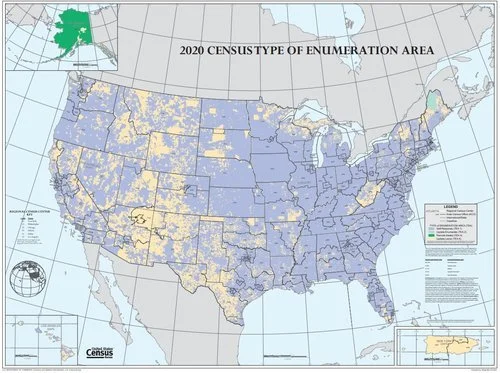
The Census also recently released a map outlining how they intend to enumerate areas throughout the country. The Bureau will employ varying invitation techniques based on how classification within the map. The following two page document provides a bit more detail as to how the Census will invite people to participate in the survey.

NATIONAL LEAGUE OF CITIES: A GUIDE (AND CHECKLIST) FOR LOCAL LEADERS
The National League of Cities is helping local leaders understand the importance of the decennial census and how to prepare for a good count. In 2018, the group published a municipal action guide for Preparing for the 2020 Census.
The action guide is a great first step to become familiar with and plan for Census 2020. The action guide has three distinct sections:
What City Leaders Need to Know. Which includes details on why the census matters, what is new for the 2020 Census, where people are counted, who is considered “Hard to Count”, and ways that people can respond.
How City Leaders Can Help? Which outlines opportunities to collaborate with the Census Bureau, integrate efforts across city and municipal departments, and how to involve the community in Complete Count efforts.
Quick Resources. These include talking points for constituents, specific community considerations, a City Checklist, Timeline of Operations, Definition of Terms, and Census 2020 Contacts.
Read the entire workbook via the link above and follow the NLC for Census updates here: nlc.org/census

Image courtesy of the National League of Cities.

CENSUS 2020 PLANNING EFFORTS IN OREGON AND WASHINGTON
1. Oregon’s Census Complete Count Committee

Project Manager, Aldo Solano
Aldo Solano serves as Oregon Governor Kate Brown’s Census Project Manager. He has previous policy and leadership experience from his roles at the Oregon Latino Health Coalition, CAPACES Leadership Institute, and Accion Politica PCUNista. Solano is charged with being the Governor’s point person for all-things Census 2020, including the challenge of working to ensure an accurate count statewide.
Oregon Complete Count Committee subcommittees
2. Washington Census Complete Count Committee

Coordinator, Lisa McLean
Lisa McLean comes to the State of Washington’s Office of Financial Management (OFM) having spent nearly twenty years with the National Democratic Institute (NDI), a non-profit that works to support and strengthen democratic institutions worldwide. McLean’s work with NDI included stints directing the organization's efforts in Iraq, Kenya, Montenegro, Croatia, and Slovakia. At OFM, McLean will be charged with developing and executing a statewide strategy to attain the most accurate enumeration of Washingtonians, including historically hard-to-count individuals, for Census 2020.
3. Census Equity Funders Committee of Oregon (CEFCO)
“As Oregon funders, we recognize the critical nature of the federal census to all the populations we aim to serve in our individual organizations, particularly (though not exclusively) because census data will affect the allocation of state and federal resources to those populations for a decade or more. We believe that collaborating and coordinating our approach as funders is the best way to support an accurate count in 2020, which in turn supports recognition of and public funding for Oregon communities.”
More information about CEFCO is available on their website or from this brochure.

4. Oregon Hard to Count Campaign Plan #WeCountOregon
Oregon partners, led by the CEFCO recently released their Hard to Count campaign plan for the 2020 Census. The #WeCountOregon plan was developed to outline a cohesive strategy for making sure that Oregon’s approximately 1.3 million hard-to-count individuals are accounted for in the upcoming 2020 Census. The plan breaks down work into five main categories: Campaign Staffing & Coordination, Systems & Infrastructure, Communications, Education, and HTC Field Outreach and can be read in full here.

CENSUS 2020: IMPORTANT DATES, 2019-2021

2019
Open Wave 1 Area Census Offices (ACOs)—January through March
Open remaining ACOs - July through September
Complete Count Committees (CCC) Plan Complete
2020
Advertising begins - early 2020
Census beings in Remote Alaska—January 21
Mailings begin to Internet First and Internet Choice cohorts
Census Day - April 1
Nonresponse Followup (NRFU) - April through July
Apportionment (state) counts to the President—December 31
2021
Redistricting counts to the states—March 31
Public Law (PL) File 94-171
For more information, check out these resources:
2020 Census Update - November 2017
2020 Census Update - January 2017
Partnership Program (page 21) and Complete Count Committees (page 24), Census presentation
Partnership Program, Cornell University
ARCHIVE: IMPORTANT PAST DATES
2018
Finalize Census 2020 question wording - March 31
End-to-End Census Test - April 1
Open Regional Census Centers (RCCs) - April
LUCA—Address verification and coordination with states/municipalities - ongoing
Partnership Program Launch
Form Complete Count Committees (CCCs)
For more information, check out the Funders’ Committee for Civic Participation (FCCP) website.

HOW IMPORTANT IS THE DECENNIAL CENSUS FOR DISTRIBUTION OF FEDERAL FUNDS?
According to the recent Census Barriers, Attitudes, and Motivators Study (CBAMS), the top three factors motivating respondents to fill out the census include: 1) helps determine funding for public services (30%), 2) it’s a civic duty (25%) and, 3) contributes to a better future for the community (17%).
The above data demonstrate that individuals realize the general importance of the decennial census for determining funding for public services, but just how important is the census for allocating funds to states, cities, and local municipalities? Andrew Reamer, a Research Professor at George Washington University, has been crunching the numbers to tackle this question. Professor Reamer reports that in Fiscal Year (FY) 2016, more than $883 Billion in federal funding (from the 55 largest federal spending programs) was guided by Census 2010 data. In Oregon, the number was more than $13 Billion (see the image below). Funding allocation for other states are available here. The largest federal program allocations in Oregon are:
Medicaid ($6.7 Billion)
Federal Student Loans ($1.3 Billion)
SNAP ($1.1 Billion)
In per capita terms, the more than $13 Billion in federal funding that Oregon received in FY2016 equates to $3,200 per Oregonian guided by Census 2010 data.
The Counting For Dollars Report, authored by Professor Reamer, can be found here.


COMMUNITY PARTNERS: AMERICA'S LIBRARIES
The American Library Association (ALA) published a brief about the important role that public libraries play in helping to ensure a complete and accurate census. The report, linked below, urges local decision makers—government agencies, complete count committees, and community organizations—to collaborate with public libraries to help people access information and technology related to the upcoming 2020 Census.

The ALA includes impressive statistics to support their case:
Over 6,000 libraries hosted U.S. Census Bureau outreach in 2010
99% of Hard-to-Count (HTC) census tracts live within five miles of a public library
Public libraries have the potential to be great partners for localized complete count efforts. However, a key challenge for local decision makers involves securing resources to fund staff time, technology, and communication efforts that will ultimately support a fair and accurate census.
The ALA Libraries’ Guide to the Census 2020 can be found here.

CENSUS BARRIERS, ATTITUDES, AND MOTIVATORS (CBAMS) REPORTS RELEASED
The U.S. Census Bureau released the results of the Census Barriers, Attitudes, and Motivators Study (CBAMS). The reports are the result of a national survey and a series of focus groups designed to provide insight into public perception of the upcoming 2020 Census. For state and local partners, the reports are important for two primary reasons: 1) the findings can help communities working on complete count efforts to identify potential barriers to participation and, 2) identify and implement strategies most effective at bolstering response rates.
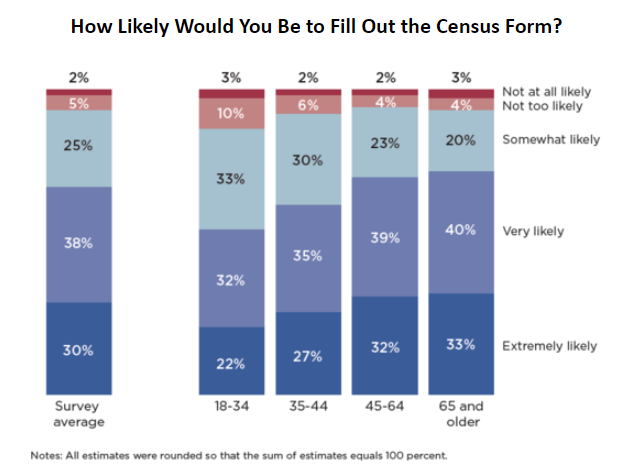
Some highlights of the two reports include:
Many people were unfamiliar with the census, with only 33 percent being “extremely” or “very” familiar. Knowledge about the purpose and process of the census was uneven across groups.
Funding for public services was a top motivator across groups, yet less than half of respondents knew that the census is used to determine community funding.
Messaging is needed for how the census directly benefits local communities, now and in the future.
Providing information about the Census Bureau’s data protection policies will not alone mitigate respondent concerns around privacy and confidentiality.
The full CBAMS Survey Report can be accessed here.
The full CBAMS Focus Group Report can be accessed here.

THE U.S. CENSUS BUREAU CONTINUES TO HIRE FOR 2020 CENSUS
The U.S. Census Bureau is actively recruiting for thousands of temporary jobs related to the 2020 U.S. Census.

Currently, the Bureau is looking to hire individuals for the following positions:
Recruiting assistants. These individuals travel throughout geographic areas to visit with community-based organizations, attend promotional events, and conduct other recruiting activities.
Office operations supervisors. These individuals assist in the management of office functions and day-to-day activities in one or more functional areas, including payroll, personnel, recruiting, field operations and support.
Clerks. These individuals perform various administrative and clerical tasks to support various functional areas, including payroll, personnel, recruiting, field operations and support.
Census field supervisors. These individuals conduct fieldwork to support and conduct on-the-job training for census takers, and/or to follow-up in situations where census takers have confronted issues such as not gaining entry to restricted areas.
Census takers. Working in the field, census takers assume a variety of roles. First, census takers work to confirm local addresses prior to the Bureau mailing the census forms. Second, once the census is mailed, census takers head into the field to interview and collect data as part of follow-up response.
For Census 2020, the Office of Personnel Management (OPM) is requiring the U.S. Census Bureau to hire U.S. citizens as census enumerators, which marks a significant change from previous censuses. More information is available here.
For more information about 2020 Census Jobs, watch this short video and visit their website.

THE DIGITAL CENSUS AND YOU: HOW TO COMPLETE THE 2020 DECENNIAL CENSUS
Census 2020: A Digital Census. One of the most significant changes from previous censuses is that the internet will be the primary response option, in addition to paper and phone.
What does this mean?
According to a Leadership Conference Education Fund policy brief, the Bureau plans on segmenting households as either “internet-first” or “internet-choice.” Households with demographic characteristics located in a geographic areas indicating consistent internet access will be classified as “internet-first” households and will be encouraged to fill out their census form on-line. Households with low internet connectivity will be labeled “internet-choice” households and will receive both the paper questionnaire and information for responding on-line.
“Internet-first” households will be mailed invitations to complete the survey online in four cohorts beginning in March 2020 (more details here). The U.S. Census Bureau hopes that by spacing out the delivery of survey access codes, they can better control response times and keep the web servers from being overwhelmed.
What about the “Digital Divide?”
Internet access varies considerably across American households. While more than 8 in 10 (81.9 percent) American households have internet access, accessibility is lower for people of color, older adults, immigrants, individuals living outside metropolitan areas, and by educational attainment and household income. Consider the following statistics from a 2016 U.S. Census report:
Among Black and Hispanic households, 72.6 and 77.3 percent, respectively, have internet access.
Among individuals 65 years and older, 67.8 percent of individuals have internet access.
The lowest rates of internet access are among limited English speaking households, households earning less than $25,000, and households where individuals have less than a high school degree. Among these three groups, internet access is 62.8, 58.8, and 56.1 percent, respectively.
For detailed maps of computer ownership and internet access by census tract, check out these maps from the National Digital Inclusion Alliance (NDIA).

Click on the image for more information about computer ownership and internet use. Image courtesy of the U.S. Census Bureau.
STATE EFFORTS TO PREPARE FOR CENSUS 2020
Across the country, states are taking action to prepare for Census 2020 by allocating funds, organizing community partners, and formulating early approaches to Get Out the Count (GOTC).
As of December 2018, the National Conference of State Legislatures (NSCL) reports the following preparation efforts (approved and pending legislation).
Complete Count Committees (CCC), State Legislation and Governor Executive Orders
Alabama
California
Colorado
Delaware
Georgia
Illinois
Kentucky
Louisiana
Michigan
Mississippi
New Jersey
New York
Pennsylvania
Washington
Legislative Funding
California
Georgia
Illinois
Maryland
Michigan
Minnesota
North Carolina
Oregon
Virginia
Washington
For more information, check out the National Conference of State Legislatures (NSCL) webpage.

STATE/LOCAL PARTNER RESOURCES
An important step to ensuring a fair and accurate count involves connecting with state and local resources. Some helpful places to start include:
1. State Data Center (SDC) member network. This network includes statistical agencies, research offices, and data-providing organizations that assist the Bureau in data dissemination at the local level.
2. The State Data Center (SDC) Clearinghouse. This is a website, maintained by the SDC Steering Committee, that provides resources, information, and links related to Census 2020.
3. State-specific materials/websites for Census 2020. These include: